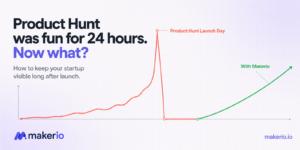
You launch your product. Maybe it’s a Product Hunt launch, maybe it’s just a tweet and a link in a few communities. For a day or two, people show up. Then the traffic falls off, and you’re left checking analytics that look almost exactly like they did before you launched.
So how to get more traffic to your website once that initial attention fades? If that’s happened to you, it’s not because your product isn’t good enough. It’s because a launch, on its own, was never designed to produce ongoing traffic. It’s an event. What happens after the event is a separate problem — and it’s the one most founders never actually solve.
This article is about that second problem: how indie hackers and startup founders turn a single launch into something closer to a traffic engine, using nothing more exotic than consistently publishing useful public updates.
Turn your product updates into a public discovery trail. Create your Makerio profile, showcase your product, and keep publishing the progress, features, and lessons that give people more ways to discover what you’re building.
The Launch-Day Traffic Trap
Product Hunt, a well-timed tweet thread, a post in a founder community — these can all produce a real burst of traffic. That burst is genuinely useful. It’s also, by design, temporary. If your Product Hunt traffic has already dropped after launch, here’s why that happens and what to do next in our guide to why startups disappear after Product Hunt
Here’s the trap: launch channels concentrate attention around a single moment. Product Hunt has a leaderboard that resets daily. A tweet has a lifespan of maybe 24 hours before it’s buried by everything posted after it. A community post gets read by whoever happens to be online that day. None of these mechanisms are built to keep sending you traffic next month, because none of them are supposed to — they’re moment-based by nature.
The mistake isn’t using these channels. It’s expecting a moment-based channel to behave like a permanent one. When founders say “traffic dried up after launch,” what usually happened is that the launch did its job, and nothing was built to take over once it was done.
The Difference Between a Traffic Spike and a Traffic Engine
It helps to separate traffic into a few distinct types, because they behave completely differently over time:
- Launch traffic — a short burst tied to a specific event (Product Hunt, a big announcement, a press mention)
- Social traffic — driven by individual posts, which fade in relevance within hours or days
- Referral traffic — visits from other sites linking to you, which can be temporary or lasting depending on the source
- Search traffic — visits from people actively looking for something, which tends to build gradually and stick around
- Repeat discovery — people who find you more than once, through more than one surface, over time
A spike is any of the first three, on their own. An engine is what you get when search traffic and repeat discovery start compounding — when there are enough genuinely useful public pages about your product that people (and search engines) keep running into them from different directions.
Building an engine means building more than one discovery surface. A single homepage is one surface. A homepage, a changelog, a handful of founder updates, and a few problem-focused articles are five.
How Public Updates Can Help You Get More Traffic to Your Website
Every time you publish something real about what you’re building, you create a new, independently discoverable page. That’s the entire mechanism, and it’s less mysterious than it sounds.
Update types worth publishing regularly:
- Product launches and major announcements
- New features
- Product improvements and fixes
- Build-in-public milestones (“we hit X users,” “we shipped Y this month”)
- Specific customer problems you solved
- Product experiments — including the ones that didn’t work
- Lessons learned, written honestly
- Founder insights and decisions
- Technical updates (architecture changes, performance work, new integrations)
- Product comparisons (“how we’re different from X”)
- New integrations
- Changelogs
- Major announcements and pivots
None of these guarantee traffic by themselves. What they do is give search engines something new and specific to index, give people something to link to, and give your product more than one entry point into a conversation. A single launch post can only ever be found by people searching for that exact launch. A year of updates can be found by people searching for dozens of different, more specific things.
The Indie Hacker Traffic Flywheel
The pattern that actually compounds looks like a loop, not a funnel:
Build → Publish → Get discovered → Earn visits → Learn what people care about → Build again → Publish again
Each pass through the loop does two things at once: it adds another discoverable page, and it tells you — through what people actually click on, share, or ask about — what’s worth building and writing about next. Founders who treat this as a loop instead of a one-time launch checklist are the ones who end up with meaningfully different traffic a year later.
A hypothetical example. Imagine an indie hacker launches a small SaaS tool with zero existing search traffic and no audience beyond a personal X account.
Month 1: They launch on Product Hunt, get a day of social traffic, and publish their first real update a few days later — a short post about a feature they added based on launch feedback.
Month 2: They start publishing consistently — a feature update, a founder post about a decision they made, and a couple of pages written around specific problems their product solves. Each one is a new, search-friendly public page that didn’t exist before.
Month 3: They keep publishing, pick up some exposure through a project spotlight on a platform they use, and start showing up for a wider range of branded and problem-specific searches simply because there’s more of them to find.
This is meant to illustrate the mechanism, not to forecast an outcome — it’s not a promise that any founder following these steps will see this exact trajectory, and it’s not “100 visitors become 10,000 automatically.” The realistic version of this story is slower and less dramatic than that. What’s consistent across founders who actually pull it off is the compounding principle: more useful public pages, published consistently, create more chances to be found.
How to Get More Traffic to Your Website Without Spending More on Ads
People search a lot of different phrasings of the same underlying question — how to get more traffic website, how to get more traffic to your website, how to increase website traffic — and most of them are really asking one of a handful of things: what to do that isn’t paid ads, and what actually works over time rather than once.
A practical list, roughly in the order it’s worth tackling:
- Publish useful product updates — not announcements, actual substance
- Turn product changes into searchable content — a changelog entry can become a full page if the change is significant
- Document lessons learned — specific, honest posts tend to get shared more than polished ones
- Create founder-focused content — people follow founders, not just products
- Participate in relevant communities — genuinely, not as a drive-by promotion
- Build internal links between related content — help visitors (and crawlers) find more of what you’ve published
- Make public pages genuinely useful — every page should answer a real question, not just exist
- Keep publishing after launch — this is the step almost everyone skips
- Track which pages and topics attract visitors — your analytics will tell you what’s resonating
- Double down on topics that show genuine interest — write more of what’s already working, not less
None of this is fast. All of it is durable — unlike a launch spike, it doesn’t stop working the day you stop paying attention to it, though it does slow down if you stop publishing.
How to Increase Traffic to Website Free
There’s a real, non-spammy version of “increase traffic to website free,” and it looks like ordinary, unglamorous work rather than a growth hack:
- Search optimization — writing pages around what people are actually searching for
- Product communities — places your specific users already gather
- Founder communities — indie hacker spaces, build-in-public groups
- Social posts — shared consistently, not just on launch day
- Build-in-public updates — progress, decisions, and honest setbacks
- Relevant community participation — including places like Reddit, where it’s genuinely useful and on-topic
- Partnerships — cross-promotion with adjacent, non-competing products
- Product directories — a handful of well-maintained, relevant ones
- Guest contributions — writing for audiences that already exist
- Founder profiles — a public presence tied to you, not just your brand
- Public changelogs — a running record of what you’ve shipped
What doesn’t belong on this list: spam, mass automated posting, fake comments, or link schemes. Search engines and communities alike have gotten better at spotting these, and even when they work briefly, they tend to damage trust with actual humans faster than they build traffic.
A 90-Day Public Update Strategy for an Indie Hacker
A realistic three-month plan for turning a launch into a habit:
Month 1 — Launch and establish a baseline. Launch through whatever channels make sense, note your starting traffic and search visibility, and publish your first one or two real updates.
Month 2 — Publish consistently. Settle into a rhythm — weekly or biweekly is enough — and start building supporting content: a couple of problem-focused pages, a founder post, better internal linking between what you’ve already published.
Month 3 — Double down on what’s working. Look at which topics and pages are actually attracting visitors, repurpose your best content into new formats, and look for legitimate distribution opportunities — including project spotlights or similar features on platforms relevant to your audience.
Keep the momentum going
A launch gives you attention. Consistent publishing gives that attention somewhere to go. Makerio gives you a public place to keep your founder profile, product, and updates discoverable as you build.
Where Makerio Fits
Everything above works whether or not you use any particular tool — the mechanism is publishing consistently, in public, in a form that can be found. Makerio is built specifically around making that easier to sustain.
Makerio gives founders a public home for product updates, a founder profile that represents the person behind the product, and a place for a project or startup to keep existing publicly after the initial launch — instead of that presence being limited to a single announcement post that stops getting updated the week after launch.
One part of this worth calling out specifically is Project Spotlight — an additional discovery mechanism where select projects get extra visibility within Makerio, giving founders one more legitimate surface beyond their own updates. It’s a supplement to consistent publishing, not a replacement for it.
It’s worth being precise about what this does and doesn’t do. Makerio doesn’t guarantee Google rankings, ChatGPT citations, Gemini visibility, or AI indexing — no platform legitimately can, since none of them control how third-party search or AI systems retrieve and select information. What Makerio does provide is structured, crawlable, publicly accessible content and an AI-friendly approach to product discovery, which — combined with genuinely consistent publishing — gives your startup more of the raw material that discoverability actually depends on.
What Consistent Traffic Actually Looks Like
It’s worth resetting expectations here: consistent traffic doesn’t usually mean viral traffic. Most founders who build a real discovery engine don’t experience a single dramatic spike — they see a gradual widening of a few specific numbers:
- Search impressions (how often you show up in search results, even before anyone clicks)
- Search clicks
- Referral visits from communities and other sites
- Returning visitors
- Branded searches (people searching your product name directly)
- General product discovery from people who weren’t looking for you specifically
- Mentions of your founder or product elsewhere online
None of this happens on a launch-week timeline. Organic discovery — through search engines or through AI-powered discovery systems — is a compounding process, and it typically takes months of consistent publishing before the trend is obvious rather than something you have to squint at.
Frequently Asked Questions
How can I get more traffic to my website?
You can get more website traffic by consistently publishing useful content, improving search visibility, participating in relevant communities, and creating more public pages around the problems your product solves. For startups, this means going beyond launch announcements: publish product updates, answer customer questions, document lessons, and connect related pages with sensible internal links.
How long does it take to increase website traffic?
Increasing organic website traffic usually takes months rather than days, but there is no reliable timeline for every startup. Results depend on competition, site history, content quality, search intent, and consistency. Early improvements may appear sooner, while meaningful search visibility often requires publishing useful content and building authority over time.
Can I increase website traffic without paid ads?
Yes, you can increase website traffic without paid ads by using organic search, useful content, founder-led publishing, relevant communities, partnerships, product directories, and social distribution. These channels require time and consistent effort rather than advertising spend. The most sustainable approach is to build several discovery sources instead of depending on one launch or platform.
Are product launches enough to generate long-term traffic?
No, a product launch alone rarely creates lasting traffic because launch platforms concentrate attention around a specific event. A launch can generate exposure, feedback, and early users, but ongoing visibility requires continued publishing and distribution. Product updates, search-focused content, founder activity, and useful public pages can create additional opportunities for people to discover your startup later.
How often should an indie hacker publish product updates?
Indie hackers should publish product updates at a sustainable cadence, with weekly or biweekly updates being reasonable when there is genuinely useful progress to share. Frequency matters less than substance and consistency. A meaningful feature, improvement, experiment, customer insight, or lesson is more valuable than publishing thin updates simply to create more pages.
What is a Project Spotlight?
A Project Spotlight is a Makerio discovery opportunity that gives selected projects additional visibility beyond their own founder profile and product updates. It can provide another surface through which people may discover a project, but it is not a guarantee of traffic, rankings, or AI visibility. It works best as a supplement to consistent publishing and distribution.
Can public product updates help with SEO?
Yes, substantive public product updates can support SEO by creating useful, specific pages that search engines can crawl, understand, and potentially index. Updates can also strengthen the overall context around your product when they are relevant and internally linked. However, publishing more pages does not automatically improve rankings; usefulness, relevance, crawlability, and overall site quality still matter.
Don’t Let Your Launch Be Your Last Discovery Moment
Your launch was the introduction. Keep giving people — and search engines — reasons to discover what you’re building.
Create your public founder profile, showcase your product, and publish updates as your startup evolves.