You launch on Product Hunt.
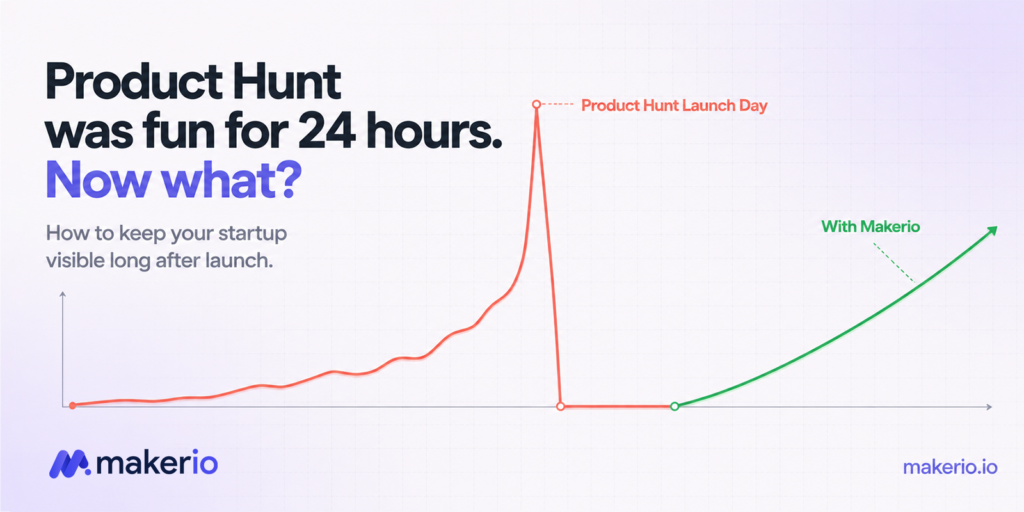
Notifications start coming in. Traffic climbs. People visit your site, leave comments, upvote, maybe sign up. For a few hours, it feels like the whole internet found out about your product at once.
Then the launch ends.
The graph drops. Traffic settles back down to whatever it was before — sometimes a little higher, sometimes almost exactly where it started.
What happens after you launch on Product Hunt?
That question is the real challenge, and it has almost nothing to do with launch day itself. Generating attention for 24 hours is a solved problem — Product Hunt is genuinely good at it. The harder problem is building discoverability that continues after launch day ends, when there’s no leaderboard, no notifications, and no built-in audience actively browsing for something new.
This article is about that second part: what to actually do once the launch spike fades, so your startup doesn’t quietly go back to being invisible.
Your Product Hunt Launch Shouldn’t Be the End of Your Visibility
Product Hunt can create the spike. Makerio helps you build what comes after it — a public founder profile, product presence, and ongoing updates that give your startup somewhere to keep being discovered.
Create Your Free Makerio Profile →
Why Product Hunt Launch Traffic Drops After Launch Day
If your traffic dropped after launching, that doesn’t mean the launch failed. It usually means the launch worked exactly as the format is designed to work — and the format is built around a single day, not an ongoing channel.
A few mechanics explain most of it:
- Concentrated launch-day attention. Product Hunt’s entire structure — the daily leaderboard, the “featured today” placement — is built to compress visibility into a narrow window rather than spread it out.
- Leaderboard competition. You’re competing with every other product launching that day for a limited number of top spots, and visibility drops off sharply below them.
- Social sharing spikes once. Your own network shares the launch once, on launch day. That’s a real, valuable push — but it’s a single push, not a recurring one.
- The Product Hunt audience is browsing, not searching. Many visitors are there to see what’s new that day, not because they were actively looking for a solution to a specific problem. That’s different from search-driven traffic, which reflects existing intent.
- Novelty drives the platform. Once your product isn’t “new” anymore, the platform’s own incentives move attention to whatever launches next.
- Notifications and referral traffic are launch-specific. The traffic Product Hunt sends you is tied to your position on that day’s leaderboard — once you’re off it, that referral source naturally shrinks.
None of this is a flaw in Product Hunt. It’s a launch platform, and it does what launch platforms do: concentrate attention around an event. The mistake founders make isn’t launching — it’s expecting a single event to behave like a permanent acquisition channel.
Product Hunt Is a Launch Channel — Not Your Entire Growth Strategy
It helps to think of discovery as two different systems that work on different timelines.
| Launch-based traffic | Evergreen discovery |
| Spikes around a launch event | Accumulates gradually over time |
| Driven by attention and novelty | Driven by search and discovery intent |
| Short campaign window | Ongoing, with no natural expiration |
| Social and referral heavy | Search, content, and community heavy |
| Mostly a one-time exposure event | Creates repeated opportunities to be found |
This isn’t “Product Hunt versus SEO.” It’s launch distribution versus ongoing distribution, and the strongest startups use both. Product Hunt can still be one of the best ways to get your first wave of users, feedback, and social proof. It’s just not built to be the thing that keeps working for you six months from now — that’s a different job, and it needs a different system.
What to Do Immediately After a Product Hunt Launch
The first week after launch sets the tone for everything after it. A simple day-by-day approach:
Day 1 — Capture. Save the testimonials, feedback, questions, and objections people raised in comments and DMs. This is some of the most honest product feedback you’ll ever get, and it’s easy to lose if you don’t collect it immediately.
Day 2 — Improve. Fix the specific friction points people flagged — a confusing signup flow, an unclear pricing page, a broken link. Quick, visible improvements based on real feedback build trust with the people who just discovered you.
Day 3 — Publish an update. Turn what you learned into a real product update, not a generic “thanks for launching with us” post. Show that the launch led to something.
Day 4 — Follow up. Reach out individually to the people who showed genuine interest — commented thoughtfully, asked real questions, or signed up. A short, specific message goes further than a mass email.
Day 5 — Publish useful content. Write something that addresses the actual problem your product solves, not a recap of the launch. This is the first piece of content built for people who find you later, not just on launch day.
Day 6 — Build community relationships. Spend time in the communities where your actual users hang out, not just the ones where you launched.
Day 7 — Review. Look at where your traffic actually came from and what people did once they arrived. This tells you what’s worth repeating and what was launch-specific noise.
Build a Website That Can Keep Getting Discovered
Your own website is the one piece of distribution you fully control, and it’s what has to do the long-term work after every other channel’s attention moves on. That means it needs more than a homepage.
A site built for ongoing discovery typically includes:
- A clear homepage that explains what the product does without requiring context from the launch
- A dedicated product page with real detail, not just a tagline
- Visible founder information — a real person behind the product
- Documentation that answers questions people actually have
- A place to publish product updates as you ship them
- A blog or content section built around real problems, not just announcements
- Sensible internal linking between related pages
- Descriptive page titles and clean, readable URLs
- Public pages that are actually crawlable — nothing important hidden behind logins or broken JavaScript
- Structured data where it’s genuinely useful
SEO in this context isn’t about sprinkling keywords into a page. It’s about making sure your site actually answers the questions people are asking — which, done well, is also what makes a page worth ranking in the first place.
How to Gain Traffic on Your Website After a Product Hunt Launch
Once the launch spike fades, traffic has to come from somewhere else. There isn’t one channel that replaces Product Hunt — there’s a set of habits that compound over time:
- Search-focused content — pages built around what people actually type into search engines when they have your problem
- Product-led content — posts that walk through real use cases, not abstract feature lists
- Problem-focused articles — content about the problem itself, which reaches people before they even know your product exists
- Build-in-public updates — founder posts about real progress, which tend to travel further than polished announcements
- Community participation — genuinely contributing in the places your users already spend time
- Legitimate directory listings — a handful of relevant, well-maintained directories, not a hundred low-quality ones
- Social distribution — sharing your content and updates where your audience actually is
- Internal linking — connecting related content so visitors and crawlers can find more of what you’ve built
- Email or newsletter distribution — a direct line to people who already opted in
- Partnerships and genuine mentions — collaborations that make sense for both sides
- Updating existing content — refreshing older pages instead of only publishing new ones
- Answering real customer questions — turning support questions and sales objections into public content
It’s worth separating traffic generation from traffic that actually matters. A viral post can spike pageviews without sending you a single qualified visitor. The goal isn’t maximizing numbers on a dashboard — it’s steadily growing the number of people who arrive already interested in what you’ve built.
Product Hunt Alternatives for Long-Term Startup Discovery
“Product Hunt alternatives” gets searched a lot, but it’s usually interpreted too narrowly — as if the answer is just a list of other launch sites. The more useful way to think about it is as categories of ongoing discovery, each doing a different job:
Startup and product discovery platforms
Other directories and discovery platforms can provide supplemental exposure and the occasional legitimate backlink. They’re worth using, but treat them the same way you’d treat Product Hunt itself — a channel, not a strategy.
Founder communities
Communities built around founders and builders — forums, niche Slack and Discord groups, build-in-public spaces — create something launch platforms can’t: relationships and recurring exposure over months, not one day.
Search-driven content
Content built around what your audience actually searches for compounds differently than launch traffic. A well-written article can keep bringing in visitors a year after you published it, long after any launch-day spike has flattened out.
Social platforms
X, LinkedIn, Instagram, and similar platforms won’t replace search traffic, but they give you a recurring way to reach an audience — especially for founders willing to share real progress instead of only announcements.
Founder and product profiles
A persistent, public profile — separate from a single launch — gives your startup another place to exist online: a page that keeps representing your product and your identity as a founder long after any individual post or launch has scrolled past.
Makerio fits into this last category. It’s built specifically as a place for the founder profile and product presence to live and grow after launch, rather than as another one-day launch event.
Why Product Updates Matter After a Product Hunt Launch
The default pattern for most startups looks like this:
Launch → silence.
The alternative is building what amounts to a public trail:
Launch → product updates → founder updates → new features → customer insights → case studies → useful articles → community discussion → long-term discoverability
Publishing an update doesn’t automatically make it rank or go viral — it’s not that direct. What it does is give people (and, increasingly, AI-powered discovery tools) more accurate, current context about what you’re building, and it gives you one more legitimate reason to be found, shared, or mentioned again. A startup with twelve months of real updates simply has more surface area to be discovered than one with a single static page from launch day.
How Makerio Helps Founders Stay Visible After a Product Hunt Launch
Makerio came out of a familiar frustration: watching a Product Hunt launch create a real spike in attention, and then watching it disappear within a week, with nothing structured left behind to keep the momentum going.
Makerio gives founders a place to:
- Create a public founder profile
- Showcase their product or project
- Publish product updates as they actually happen
- Maintain a persistent public presence that doesn’t reset after launch day
- Build a real history around what they’re working on
- Present startup information in a way that’s easier for people — and search and discovery systems — to understand
On the AI side specifically, it’s worth being precise: Makerio doesn’t get anyone indexed by ChatGPT, and it doesn’t guarantee Google rankings or AI visibility. What it does is more modest and more honest — Makerio is designed to support discoverability in an AI-first web by giving startups structured, public, and continuously updated information. That’s a meaningfully different claim than a promise of results, and it’s the accurate one. If you want the fuller technical picture of how that works, “How AI Search Engines Discover Startups in 2026” covers it in more depth.
A Simple Post-Product-Hunt Visibility System
A repeatable framework, rather than a one-time checklist:
- Launch — Use Product Hunt and any other relevant launch channels.
- Capture — Collect feedback, testimonials, questions, and user insights while they’re fresh.
- Publish — Turn what you learned into product updates, articles, and founder content.
- Distribute — Share that content through communities and social platforms.
- Build discoverability — Maintain useful public pages with sensible internal links.
- Keep updating — Continue publishing instead of going quiet after launch.
- Measure — Track organic traffic, referral traffic, branded searches, signups, qualified visitors, and conversions.
Vanity metrics — raw pageviews, upvote counts — are easy to obsess over and don’t tell you much on their own. The system above is designed to point at the things that actually indicate people are finding and using what you built.
A 30-Day Post-Launch Plan
For a solo founder or small team, a realistic month looks something like this:
Week 1 — Post-launch cleanup. Process feedback, fix friction points, follow up with genuinely interested people.
Week 2 — Publish. Turn launch learnings into a product update and at least one piece of useful content.
Week 3 — Distribute and connect. Spend deliberate time in relevant communities and build real relationships, not just drive-by promotion.
Week 4 — Tighten the foundation. Review analytics, improve internal linking, update older content, and note what’s actually working before planning month two.
Turn your post-launch work into a public trail
Don’t let your launch feedback, product updates, and progress disappear into private notes. Build a public presence around what you’re actually shipping and give people another way to discover your startup after launch day.
Start Building Your Makerio Profile →
Should You Still Launch on Product Hunt?
Yes — if it fits your product and audience.
Product Hunt remains genuinely useful for early exposure, direct feedback, early adopters, social proof, and a real jolt of launch-day momentum. None of that is in question.
The mistake isn’t launching. It’s treating launch-day exposure as the finish line instead of the starting point of an ongoing visibility system.
The Long-Term Alternative to “Launch and Disappear”
The pattern to avoid:
Launch → spike → silence.
The pattern worth building instead:
Launch → publish → update → distribute → build → repeat.
Long-term visibility isn’t the result of one good launch day. It’s the compounding result of consistently doing useful, visible work after it — which is a less exciting story than a launch-day spike, but a far more reliable one.
Want more ongoing visibility for your startup? Explore Makerio Sponsorship
Your Product Hunt launch was the beginning — not the finish line. Create your Makerio profile, showcase your product, and keep publishing updates that build a searchable history around what you’re building.
🚀 Create Your Free Makerio Profile →
Learn how Makerio approaches AI visibility in “How AI Search Engines Discover Startups in 2026“
FAQ
How can I keep my startup visible after a Product Hunt launch?
You can extend post-launch visibility by building public assets that continue to attract discovery after launch day, including useful website content, product updates, founder information, community mentions, and searchable product pages. Product Hunt creates a burst of attention; your ongoing visibility system gives people more opportunities to discover your startup afterward.
Is Product Hunt still worth using in 2026?
Yes, Product Hunt can still be valuable for early exposure, product feedback, early adopters, and social proof. The key is to treat it as a launch channel rather than your entire acquisition strategy. After launch day, redirect that attention toward your website, content, community relationships, product updates, and other long-term discovery channels.
What are the best alternatives to Product Hunt for startup discovery?
The strongest alternatives depend on how you want people to discover your startup. Founder communities, relevant startup directories, search-driven content, social platforms, and persistent founder or product profiles can all support ongoing discovery. Instead of replacing Product Hunt with one platform, founders should build several complementary sources of visibility.
How can I gain traffic on my website after a Product Hunt launch?
You can grow post-launch website traffic through search-focused content, product-led articles, community participation, product updates, internal linking, legitimate external mentions, and direct audience channels such as email. The goal is to create multiple ways for potential customers to discover your startup after Product Hunt’s referral traffic naturally declines.
How can I get website traffic without paid advertising?
You can generate organic website traffic through useful search-focused content, founder-led publishing, community participation, product updates, relevant directories, partnerships, and genuine external mentions. These channels usually require more time than paid advertising, but they can continue attracting visitors after publication instead of stopping when an advertising budget runs out.
How long does startup SEO take to produce results?
Startup SEO usually takes months rather than days to develop meaningful organic visibility, but there is no reliable universal timeline. Results depend on competition, website quality, content relevance, authority, technical accessibility, and the site’s existing history. Founders should treat SEO as a compounding acquisition channel rather than an immediate traffic source.
Should I keep publishing product updates after launch?
Yes, publishing genuine product updates helps keep your startup’s public information current and gives users, search engines, and discovery systems more context about what you are building. Updates should document meaningful changes, new features, lessons, or milestones rather than exist purely for SEO. Consistent publishing also creates a searchable history around your product.
How can Makerio help my startup after Product Hunt?
Makerio helps founders maintain a public presence after launch through a founder profile, product page, and ongoing product updates. This gives your startup a persistent place to explain who is building it, what the product does, and how it evolves. Makerio supports discoverability fundamentals but does not guarantee Google rankings or AI recommendations.