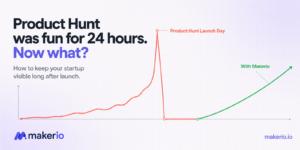
You launch on Product Hunt. Maybe you post on Hacker News the same morning, share it across X and LinkedIn, and ask a few friends to upvote. For 24 to 48 hours, the traffic is real: people click through, some sign up, a few leave comments.
Then it stops.
By the following week, most of that traffic is gone, and your product is back to relying on whoever happens to type your exact name into a search bar. This is the part founders don’t plan for: launch day is an event, but discovery has to keep happening long after the event ends.
What’s changed in the last couple of years is how that ongoing discovery happens. People aren’t only typing keywords into Google and scanning ten blue links anymore. They’re asking AI assistants to recommend a tool for a specific problem, summarize what a startup does, or compare a handful of options before they’ve visited a single website. Whether and how a startup shows up in those conversations depends on something founders rarely think about: whether clear, structured, up-to-date information about their product actually exists somewhere these systems can find, understand, and reuse.
That’s the gap an AI visibility platform is meant to address — not by promising a spot in someone’s AI-generated answer, but by giving a startup a public, structured, continuously updated presence that search engines, people, and AI-powered discovery systems all have a fair shot at finding.
This article walks through how AI product discovery actually works, how it differs from traditional SEO, why a single static landing page tends to run out of runway, and what founders can practically do about it.
🚀 Want your startup to stay visible after launch?
Create your free Makerio profile, showcase your product, and start publishing updates that build a lasting public presence.
How AI Search Is Changing Startup Discovery
A few years ago, “getting found” mostly meant one thing: ranking on a search engine results page. That’s no longer the whole picture. Today, AI product discovery is happening through a mix of channels:
- Traditional search engines
- AI-powered search tools and assistants
- Conversational, chat-based answers
- Recommendation and comparison features inside AI products
- AI-generated summaries that sit above traditional search results
- Peer comparisons and threads on communities like Hacker News, Reddit, and X
- Curated directories and structured listing sites
It’s tempting to think of AI search as just “Google SEO with an AI label slapped on top.” It isn’t. Traditional search engines built their reputation on crawling the web and ranking pages against a query. AI-powered systems do something related but different: many of them retrieve information from a mix of sources — general web indexes, specialized retrieval systems, structured data, and in some cases real-time web access — and then synthesize an answer, recommendation, or comparison from whatever they can reliably piece together.
The practical consequence for founders is straightforward, even if the underlying systems are complex: the fewer places your startup’s information lives in a clear, consistent, machine-understandable form, the fewer chances AI product discovery systems have to find and use it.
How AI Search Engines Discover Startups
None of this requires a computer science degree to understand at a working level. A handful of concepts explain most of what matters:
Web crawling. Before any system — traditional or AI-powered — can reference your startup, something has to be able to visit your public pages and read them. Google’s crawling documentation explains how automated crawlers access web content. If a page is blocked, hidden behind a login, or only reachable through JavaScript that isn’t rendered properly, it may never get picked up in the first place.
Structured information. Search and retrieval systems work better when facts are presented plainly rather than buried in marketing copy: what the product is, who it’s for, what category it belongs to, who runs it. Structured data markup (schema.org and similar formats) gives machines an explicit, unambiguous version of these facts alongside the human-readable page.
Entities and relationships. A startup, a founder, and a product are treated as distinct but connected “entities.” Search and AI systems do better when the connections between them are consistent across the web — the same product name, the same founder name, the same core description — rather than fragmented across pages that don’t quite agree with each other.
Freshness. A page that hasn’t changed in two years signals something different than one that’s actively maintained. Regular, genuine updates give crawlers and retrieval systems a reason to revisit and re-index your content.
Authoritative references. Mentions and links from other credible sources — press coverage, community discussion, directories, partner sites — act as external confirmation that a startup exists and is worth referencing.
Retrieval and indexing systems. Different AI products are built on different retrieval architectures, and they don’t all source information the same way or on the same schedule. Some lean more heavily on pre-built indexes; others incorporate more live web access. What’s consistent across most of them is that clearly written, well-structured, easily crawlable content is easier to retrieve accurately than content that’s vague, inconsistent, or hard to access.
Why a Static Startup Landing Page May Not Be Enough
Most startups launch with a single homepage: a headline, a short product description, a screenshot or two, and a signup form. That page can absolutely do its job on launch day. The problem is what it doesn’t contain.
A static presence typically has:
- One homepage
- A brief, general product description
- Little to no fresh content after launch
- Few external references pointing back to it
- Minimal information about the founder or team
A persistent presence typically has:
- A public founder profile
- A dedicated product or project page
- Regular, substantive updates
- Additional useful content built up over time
- Structured, machine-readable information
- Multiple relevant, interlinked pages
- Consistent entity information (same names, same descriptions, same facts) across all of it
To be clear: publishing more pages doesn’t automatically improve rankings or AI visibility, and treating page count as a metric to game is a good way to produce thin, forgettable content. What actually matters is whether each page is useful, accurate, and crawlable, and whether it adds a real signal about who you are and what you’re building — not whether it exists at all.
Traditional SEO vs AI Visibility
Traditional SEO and AI-era discoverability overlap heavily, but they’re not identical disciplines. Here’s how they compare on the fundamentals:
| Traditional SEO | AI Visibility / AI Search Discoverability | |
| Primary goal | Rank a page for a search query | Be accurately understood and referenced by retrieval and answer systems |
| How users search | Keyword-based queries | Natural-language questions, comparisons, and requests |
| Importance of crawlability | Essential | Essential — and often less forgiving of blocked or JS-heavy pages |
| Content structure | Headings, keywords, metadata | Clear facts, structured data, unambiguous entity information |
| Freshness | Helpful ranking signal | Often a stronger signal for continued retrieval and re-indexing |
| Entity/context | Useful but secondary | Central — consistent identity across pages and sources matters a lot |
| Output format | A ranked list of links | A synthesized answer, summary, or recommendation |
| Links and references | Backlinks as an authority signal | External mentions as corroborating context, not just link equity |
| User intent | Matching a query to a page | Matching a need to an accurate, trustworthy answer |
None of this means traditional SEO is dead — it’s the opposite. Crawlability, indexability, clean technical structure, and genuinely useful content are still the foundation everything else is built on. AI-era discovery doesn’t replace that foundation; it adds a second layer of considerations on top of it.
What Is AI Visibility Optimization?
AI visibility optimization is the practice of structuring and maintaining public information about a startup so that it’s easier for search engines, AI-powered systems, and actual humans to find, understand, and accurately reference.
It’s not a separate technical discipline that competes with SEO — think of it as a set of habits layered on top of solid SEO fundamentals:
- Write clear, specific product descriptions instead of vague positioning language
- Keep brand and product information consistent across every page and platform
- Maintain a public founder identity, not just a company brand
- Structure pages with clear, descriptive headings
- Publish product updates that add real information, not filler
- Use structured data where it’s genuinely appropriate
- Make sure important pages are actually crawlable and indexable
- Link internally between related pages in a way that makes sense to a reader
- Earn authoritative external references rather than manufacturing them
- Produce original content instead of recycling generic boilerplate
It’s worth saying plainly: none of this is a guaranteed ranking formula, and any platform or article that promises otherwise is overselling. What these practices do is give search engines and AI systems better raw material to work with. What they do with that material is still up to them.
How AI Product Discovery Works for Startups
AI product discovery is the process by which AI-powered tools help someone find, understand, or compare products — often without that person ever running a traditional search. To be a good candidate for that process, a startup needs to communicate a handful of things clearly, ideally in more than one place:
- What the product actually does — described in plain language, not just a tagline
- Who it’s for — a specific audience, not “everyone”
- The problem it solves — the actual pain point, not an abstraction
- Its category — so it can be grouped correctly alongside comparable tools
- What makes it different — the real differentiator, not a generic claim
- Who’s behind it — a real founder or team, not an anonymous brand
- What’s changed recently — product updates that show it’s active and maintained
Here’s a small example of why specificity matters. “A productivity tool for teams” is vague enough to mean almost anything, and vague descriptions are genuinely harder for both humans and machines to parse and categorize correctly. “A shared meeting-notes tool built for remote engineering teams that sync with Linear and Slack” is a sentence a human can evaluate at a glance — and it’s also a sentence that gives a retrieval system unambiguous facts to work with: category, audience, and integrations, all in one place. The same clarity that helps a person decide whether to click “sign up” is what helps a machine decide whether your product is a good match for an AI product discovery query.
How Makerio Is Built for the AI Discovery Era
Makerio was built around one specific problem: what happens after launch day.
A launch platform is designed to create a spike. It isn’t designed to give that spike a second life a month later, or to make sure the information about your startup still exists somewhere useful once the spike has passed. Makerio takes a different starting point — unlike noisy social feeds or automated link directories, it’s built as a curated AI visibility platform strictly limited to 3 quality updates per day. Its job isn’t to generate a single burst of attention, but to give founders a structured, persistent public presence that can keep being found long after that.
Concretely, that means:
- A curated environment strictly limited to 3 quality product updates per day, ensuring your work never gets buried in a spammy feed
- A public founder profile, so there’s a real identity behind the product, not just a brand
- A public product or project page with a clear, structured description
- The ability to publish ongoing product updates
- Structured startup information that stays consistent across pages
- Search-friendly public pages built to be crawlable and indexable
- Content that accumulates over time instead of sitting static
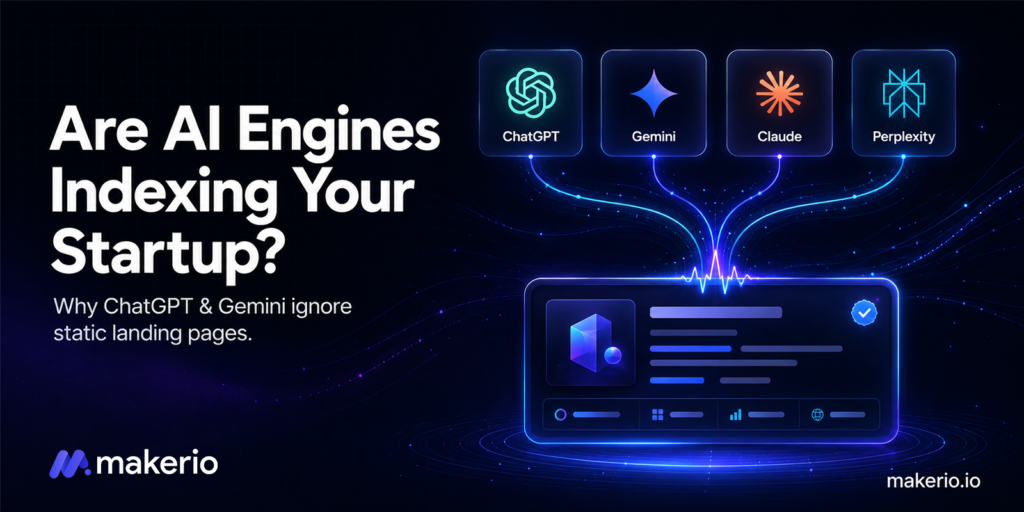
It’s important to be direct about what this does and doesn’t promise. Makerio does not guarantee that ChatGPT, Gemini, Claude, Perplexity, or any other AI system will index, cite, or recommend a given startup — no platform legitimately can promise that, because none of them control how third-party AI systems retrieve or select information. What Makerio provides instead is a structured public environment designed to make a startup’s information easier for search engines, real people, and AI-powered discovery systems to find and understand, using the same fundamentals — crawlability, structure, consistency, freshness — described throughout this article.
The idea underneath all of it is simple: don’t just launch once — build a public trail that supports AI product discovery over time.
In practice, that looks like:
- Creating a founder profile that represents you, not just your company
- Adding your product or project with a clear, specific description
- Publishing product updates as you actually make progress
- Continuing to build a public history around what you’re working on
- Giving both people and search/discovery systems more context, over time, about what you’re building and why
One launch gives you a moment. A public trail gives search engines and AI systems something to keep finding.
A Practical AI Visibility Checklist for Startups
A working checklist, in roughly the order it’s useful to tackle it:
- Create a clear public product page — one page that fully explains what you’ve built
- Clearly explain the problem and solution — in plain language, not jargon
- Create a public founder profile — a real identity, separate from the brand
- Keep product information consistent — the same description and facts everywhere you appear
- Publish useful product updates — real progress, not filler posts
- Use descriptive page titles — specific enough to be understood out of context
- Use descriptive headings — so both readers and crawlers can scan structure quickly
- Implement structured data where appropriate — to make key facts machine-readable
- Make important pages crawlable — check that nothing critical is blocked or hidden
- Create strong internal links — connect related pages in a way that makes logical sense
- Earn legitimate external mentions — press, communities, directories, partners
- Avoid thin or duplicate content — every page should say something the others don’t
- Keep important information updated — stale facts hurt trust and freshness signals alike
- Build topical authority over time — depth in your category, not just breadth
None of these items is a silver bullet on its own. Together, over time, they’re what a durable public presence actually looks like.
Ready to build your startup’s public trail?
Don’t let your launch become a one-day event. Create your Makerio profile and start building a searchable history around your product.
Does AI Visibility Replace SEO?
No.
Technical SEO fundamentals — crawlability, indexability, page speed, quality content, backlinks, and matching content to real search intent — are still the foundation of being found online, by humans and machines alike. AI visibility isn’t a replacement for that work; it’s an extension of it, built for a world where discovery no longer happens exclusively through a search engine results page.
Founders who treat AI visibility as a substitute for SEO fundamentals, rather than an addition to them, are usually building on a weaker foundation than they realize.
The Future of Startup Discovery
Startup discovery is becoming more multi-channel, not less. Founders now compete for attention across Google, AI-powered search and assistants, social platforms, communities, startup directories, and founder networks — often simultaneously, and often through channels a founder doesn’t fully control.
It’s hard to say with confidence exactly how any one of these channels will evolve, and any article that claims otherwise is guessing. What’s reasonably clear is the strategic takeaway: relying on a single launch platform or a single channel puts a startup’s discoverability entirely at the mercy of that one channel’s algorithm, policies, and attention span. Spreading a consistent, accurate public presence across multiple channels doesn’t guarantee results, but it does reduce that single point of failure.
Final Takeaway
Your launch is an event. Your visibility should be an ongoing asset.
A launch platform gets you attention for a day or two. What determines whether people — and increasingly, AI-powered systems acting on their behalf — can still find and accurately understand your startup a month or a year later is whether you kept building a public presence after that day ended. That’s the specific gap Makerio is designed to help founders close: not a promise of AI rankings, but a structured place to keep publishing the information that makes discovery possible in the first place.
Ready to stay visible after launch?
Create your founder profile, showcase your product, and start publishing updates that keep your startup discoverable long after launch day.
Want more ongoing visibility for your startup? Explore Makerio Sponsorship
FAQ
What is an AI visibility platform?
An AI visibility platform helps startups build a structured public presence that can be discovered and understood by search engines and AI-powered discovery systems. For founders, this typically means maintaining clear product information, a public founder profile, useful updates, crawlable pages, and consistent information that can support long-term online discoverability.
How do AI search engines discover startups?
AI search engines can discover startups through AI product discovery, web crawling, search indexes, retrieval systems, structured information, and other publicly available sources. Startups improve their chances of being understood when their product, founder, category, and current information are clearly presented on crawlable public pages and supported by legitimate mentions across the web.
What is AI product discovery?
AI product discovery is the process of using AI-powered search and recommendation systems to find, understand, compare, or evaluate products. For startups, clear descriptions of the product, target audience, problem solved, category, features, and recent updates give these systems more useful context when matching products to relevant searches or questions.
Does traditional SEO still matter for AI search?
Yes, traditional SEO remains an important foundation for AI search visibility. Crawlability, indexability, useful content, search intent, technical performance, internal linking, and legitimate external references can all help establish a strong public web presence. AI visibility builds on these fundamentals rather than replacing conventional search engine optimization.
How can startups improve AI visibility?
Startups can improve AI visibility by making their public information clear, consistent, crawlable, and genuinely useful. Founders should maintain accurate product and founder information, publish meaningful updates, use structured data where appropriate, create logical internal links, and earn legitimate external mentions. These practices improve the information available to search and AI retrieval systems without guaranteeing a particular result.
Does getting indexed by Google guarantee AI visibility?
No, being indexed by Google does not guarantee that a startup will appear in AI-generated answers. Google Search and individual AI systems use different technologies, indexes, retrieval methods, and selection processes. Google indexing is a useful part of a startup’s overall discoverability strategy, but inclusion in ChatGPT, Gemini, Perplexity, or another AI system cannot be guaranteed.
How does Makerio help startups stay visible after launch?
Makerio helps startups maintain a public presence after launch through founder profiles, product or project pages, and ongoing product updates. Instead of relying entirely on a short-lived launch spike, founders can build a searchable history around what they are creating. This gives people, search engines, and AI-powered discovery systems more public information to find and understand over time.