 Peerlist, PeerPush, Launch Llama & More
Launching a product is not the same as clicking “publish.”
You can build a solid SaaS product, write a decent landing page, submit it somewhere, and still hear nothing. The first people to notice a new product rarely find it by accident. They find it because you gave them a clear reason to care, put it where they were already looking, and talked to them when they showed up.
PeerPush is one place to do that. It is built around product discovery, with listings for SaaS products, AI tools, developer tools, and other products from makers and startups. It also gives founders ways to keep their products visible through updates and milestones rather than treating a launch as a single event.
This PeerPush launch guide walks through the whole journey: what PeerPush is, whether PeerPush is legit, how to prepare and publish a launch, how to promote it, how to turn visitors into users, and how to learn from the feedback that comes back.
Platform details can change, so always check PeerPush’s current pricing, rules, and submission flow before planning a launch around a specific feature or promotion.
What Is PeerPush?
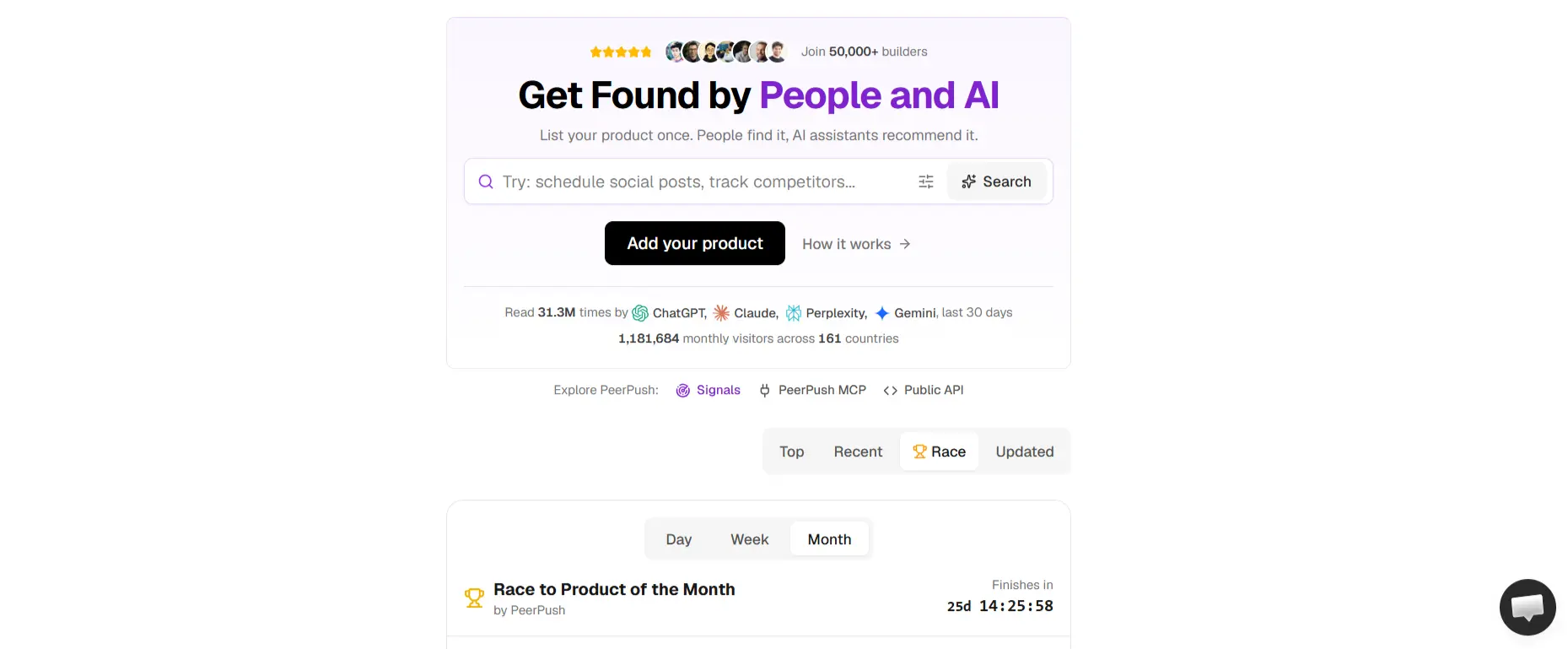
PeerPush is a product discovery platform for indie makers, startups, and tech enthusiasts. The platform describes itself as a place where people and AI can discover products, with structured product information that helps people and AI assistants understand what a product does, who it is for, and how it can be used.
That makes PeerPush more than a traditional directory. A founder can publish a product, receive ratings and comments, share updates, showcase growth milestones, and keep building visibility after the initial launch.
PeerPush currently reports more than 1.1 million monthly visitors, 32,000+ newsletter subscribers, and 50,000+ active builders. These are figures published by PeerPush itself, so treat them as platform-reported audience metrics rather than a guarantee of traffic for an individual product.
The platform includes products across categories such as:
- SaaS and micro-SaaS
- AI tools
- Developer tools
- Browser extensions
- Startup products
- Indie projects
- Other technology products
For founders, the main value is discovery. You are putting your product in a place where people are already browsing new software and tools instead of relying entirely on your existing audience.
That can be especially useful when you are launching your first product, validating a new idea, or trying to get your first few users without spending heavily on advertising.
Is PeerPush Legit?
It is a reasonable question to ask before spending time or money on any launch platform.
The strongest way to answer “is PeerPush legit?” is to look at how the platform operates rather than simply accepting marketing claims.
PeerPush has publicly available rules, pricing, product listings, and engagement mechanics. Its rules explain how members can earn PeerPush Points through actions such as upvoting products, commenting, following, rating, visiting product websites, and favoriting comments or product updates. There are daily limits on several of these activities, and the platform says points become less influential when members stop engaging over time.
PeerPush also publishes how product rankings are calculated. Its scoring system considers engagement, PeerPush Points, ratings, click-through activity, freshness, verified links, and badges, with anti-gaming measures intended to prevent any single signal from dominating the score.
The platform also has public pricing and a free submission option. That means a founder can test the platform without necessarily paying for a launch promotion.
There are still reasons to evaluate the results yourself.
A platform can have a large reported audience without every product receiving the same level of attention. Some launches will attract more clicks and comments than others depending on the product, positioning, audience, timing, and promotion.
So, is PeerPush legit?
PeerPush appears to be a functioning product-discovery platform with public listings, published rules, transparent pricing, and an active product ecosystem. Whether it is worth your time or money is best determined by the traffic, users, and feedback you actually get from your own launch.
A sensible approach is to test the free option where appropriate, track your results, and only spend more when you understand what the platform is doing for your product.
Before You Launch on PeerPush, Get Your Product Page Right
Most weak launches do not fail because the platform is necessarily wrong. They fail because visitors cannot understand the product quickly enough.
You have only a few seconds to answer three questions:
What is it? Who is it for? Why should I care?
Your product page should make those answers obvious.
The essentials
Product name: Keep it easy to say, spell, and remember.
One-line value proposition: Explain the user and the outcome, not just the technology.
Problem statement: Describe the pain in language your target customer actually uses.
Target audience: Be specific. “For freelance designers” is stronger than “for everyone.”
Screenshots or a demo: Show the actual product whenever possible.
Landing page: Make sure the destination page works properly on mobile and loads quickly.
Call to action: Give visitors one obvious next step such as “Start free,” “Try the demo,” or “Join the waitlist.”
Pricing or trial information: If people need to search for the price or figure out how the trial works, some will simply leave.
Examples by product type
SaaS:
“Invoice reminders for freelancers who hate chasing clients.”
Show the dashboard, reminder system, and workflow rather than leading with a generic stock illustration.
AI tool:
“Turn a messy meeting transcript into action items in 30 seconds.”
Show the input and output so visitors can understand the transformation immediately.
Developer tool:
“Replay any webhook locally with one command.”
Include a short code example or terminal demo.
Browser extension:
“Hide distracting sidebars on any website.”
Show a real before-and-after example.
Indie product:
“A simple habit tracker with no accounts and no subscription.”
Explain what makes the product different instead of using a vague description.
A simple test
Show the product page to someone who knows nothing about it for ten seconds.
Then ask:
“What does this product do, and who is it for?”
If they cannot answer, rewrite the page before you launch.
How to Launch a Product on PeerPush
The exact submission flow can change, so check the current PeerPush interface when you publish. The basic process is straightforward.
1. Create your account and explore the platform
Before submitting your own product, browse a few existing listings.
Look at how products explain their value, what information they include, and how makers communicate with people who comment.
PeerPush currently lets founders submit a URL and use AI to auto-fill product information or enter the details manually. Product pages can include use cases, target audiences, pricing, supported platforms, alternatives, screenshots, and descriptions.
Take the time to review those details yourself rather than treating a generated listing as finished copy.
2. Participate genuinely
PeerPush has a points system tied to actions such as upvotes, comments, follows, ratings, product visits, and favorites. The platform also limits how many points can be earned from several activities each day.
Use those features because you are genuinely interested in the products you interact with.
Do not click, rate, or comment simply to accumulate points. The goal should be genuine participation and useful interaction, not artificially inflating engagement.
3. Prepare your launch assets
Before you submit, have these ready:
- Product name
- Tagline
- Description
- Target audience
- Product URL
- Screenshots or demo
- Pricing information
- Trial or signup details
- A clear call to action
PeerPush can help structure product information, but review everything yourself before publishing. Your own positioning should be more important than automatically generated copy.
4. Choose how you want to publish
PeerPush currently offers a free submission that enters a publishing queue.
Its paid options provide instant publishing and additional promotional visibility. Current pricing lists:
- Standard: $39 one-time for instant publishing
- Launch + 7d Promotion: $89 one-time
- Launch + 30d Promotion: $229 one-time
The paid promotion plans currently advertise approximately 20,000 estimated impressions for the 7-day plan and 100,000 estimated impressions for the 30-day plan.
These prices and promotional estimates can change, so check the live PeerPush pricing page before paying.
For a first experiment, starting with the free route can make sense. Once you know your page converts attention into meaningful activity, you can decide whether additional promotion is worth paying for.
5. Review everything before publishing
Read your launch page as if you were a stranger.
Check:
- Spelling
- Product claims
- Links
- Screenshots
- Pricing
- Signup flow
- Mobile experience
- Call to action
A broken signup button can waste more launch traffic than a weak headline.
6. Stay active after publishing
Do not treat the launch as finished the moment your product goes live.
Watch comments and ratings. Answer questions. Share updates when you ship something meaningful. Let people see that there is a real founder behind the product.
PeerPush explicitly supports build-in-public activity through product updates, milestones, and growth information, which gives founders reasons to keep the listing active over time.
What Makes a PeerPush Launch Worth Clicking?
People click when they understand the product quickly.
Clever wording can help, but clarity comes first.
Lead with the outcome
“Cut invoice chasing from hours to minutes” is more compelling than:
“An AI-powered financial workflow platform.”
The first tells the reader what changes.
Be specific
Only use measurable claims when they are true and defensible.
Instead of:
“Save hundreds of hours every month.”
Try:
“Automatically email clients three days before an invoice is due.”
Specificity creates trust.
Show the product
A screenshot, short demo, GIF, or before-and-after example can explain more than several paragraphs of copy.
For software products, showing the workflow is often more persuasive than describing every feature.
Speak to one audience
“For indie SaaS founders tracking MRR” is more useful than “for modern businesses.”
You do not need everyone to click. You need the right people to click.
Add founder context
A short, honest explanation of why you built the product can make a launch feel more human.
For example:
“I kept losing track of failed payments across different dashboards, so I built one place to monitor them.”
Use founder stories when they are genuine. Do not manufacture a dramatic origin story for marketing purposes.
How to Promote a Launch on PeerPush
Publishing the listing gives you a destination.
Promotion gives people a reason to visit it.
A useful rule is:
Promotion means bringing relevant people to your launch. Spam means pushing your link everywhere without context.
For a small startup, useful channels include:
X and LinkedIn: Share the story behind the product, what you learned while building it, or the problem you’re trying to solve instead of posting the same launch URL repeatedly.
Newsletter: Your existing subscribers are often your warmest potential users.
Relevant communities: Share where the product genuinely fits the conversation and follow the community’s rules.
Existing customers: Ask users who already know the product to share honest feedback.
Founder networks: Ask peers for feedback rather than asking everyone for a vote.
Personal outreach: A thoughtful message to ten people who actually have the problem can be more useful than a generic post seen by thousands.
Build-in-public audiences: Share progress, experiments, mistakes, and lessons throughout the launch.
What to avoid
Do not rely on:
- Vote exchanges
- Bots
- Fake accounts
- Automated comments
- Artificial engagement
- Spammy mass outreach
Even when these tactics create activity, they do not necessarily create customers.
The better goal is simple:
Get the right people to look at the product, try it, and tell you what they think.
PeerPush Launch Tips for Indie Hackers
For solo founders with small audiences, a few habits matter more than complicated growth tactics.
Launch when you can be available
Early comments can shape the conversation around your product. Be present when people start engaging.
Explain the product in one sentence
If the founder cannot explain the product clearly, visitors will struggle even more.
Answer questions specifically
“Thanks!” is polite, but it doesn’t add much.
A stronger response addresses the actual question and gives the person something useful.
Share something besides the link
A lesson from building the product, a surprising customer insight, a design decision, or a real product update gives people a reason to pay attention.
Keep updating the product page
When you ship a meaningful improvement, document it.
A launch that shows movement can feel very different from a product that appeared once and disappeared.
Treat comments as research
Record:
- Questions
- Objections
- Confusion
- Feature requests
- Positive reactions
- Pricing concerns
Repeated confusion is especially valuable. If several people misunderstand the same part of your product, that is a positioning problem worth fixing.
Use tracking links
Add UTM parameters to the URL you submit so you can separate PeerPush traffic from visitors arriving through other channels.
How to Get Users from PeerPush
Getting traffic is not the same as getting users.
A visitor looked at the page.
A user signed up, experienced the product’s value, and had a reason to come back.
Think about your funnel like this:
PeerPush discovery → landing page → signup → onboarding → activation → retention
Every step can lose people.
Your job is to make each transition easier.
Reduce signup friction
Do not ask for information you don’t need.
Make the signup process as simple as the product allows.
A free plan or trial can also make sense for some products, especially when the visitor can experience the value quickly.
Make the next action obvious
Avoid giving visitors five competing CTAs.
Choose the action you most want them to take.
Get users to value quickly
The shorter the path between signup and the first useful result, the better.
For example:
Bad onboarding:
Create account → verify email → create workspace → configure settings → invite team → watch tutorial → finally use product.
Better onboarding:
Create account → enter one piece of information → get a useful result.
Show the product before asking for commitment
A demo, sample account, interactive preview, or clear screenshots can remove hesitation.
Capture people who are not ready
Not every visitor will sign up immediately.
A waitlist, email capture, newsletter, or useful resource can give you another way to stay in touch.
Follow up personally
Your first users are unusually valuable.
Ask:
“What were you hoping this would help you do?”
Then listen.
That answer can improve your landing page, onboarding, pricing, and even the product itself.
What Should You Measure?
Do not judge the launch only by how many people visited your page.
| Metric | What it tells you |
|---|---|
| Visitors | Whether your launch attracts attention |
| Signups | Whether visitors want to try the product |
| Activation | Whether new users reach a meaningful first result |
| Trial starts | Whether the offer is compelling |
| Product usage | Whether users continue engaging |
| Replies and demos | Whether people care enough to start a conversation |
| Paying customers | Whether the product can turn interest into revenue |
There is no universal “good” conversion number for every PeerPush launch.
Measure your own funnel and look for where the biggest drop happens.
How to Get Feedback on PeerPush
One of the most useful outcomes of a launch can be learning what people misunderstand.
Instead of asking:
“What do you think?”
Ask questions that are easier to answer.
Try:
- “What confused you?”
- “What did you think this product did?”
- “What would stop you from trying it?”
- “What would make this useful every week?”
- “What would make you willing to pay?”
- “What would you expect to happen after signing up?”
These questions produce more useful information than generic praise.
Look for patterns, not requests
One person asking for a new feature is an opinion.
Three people misunderstanding your headline is a finding.
Three users struggling with the same onboarding step is a product problem.
Collect the feedback in one place and group it into categories such as:
- Positioning
- Onboarding
- Bug
- Missing feature
- Pricing
- Usability
Then prioritize repeated problems rather than implementing every request you receive.
Close the loop
When someone gives useful feedback and you act on it, tell them.
A simple:
“You mentioned this was confusing — we fixed it.”
shows that their input mattered and can encourage better feedback next time.
PeerPush for Indie Hackers and SaaS Founders
PeerPush can be particularly relevant to founders who are still building their initial distribution.
That includes:
- Solo founders
- Indie hackers
- Bootstrapped SaaS companies
- Micro-SaaS products
- AI startups
- Developer tools
- Browser extensions
- Side projects
The potential benefits are practical:
Discovery: A public product page gives people another way to find you.
Early users: The right visitor can become an actual tester or customer.
Feedback: Comments and conversations can reveal problems that analytics cannot.
Positioning validation: You can learn whether people immediately understand what you’re building.
Traffic: Your listing can become another referral source for your website.
But there is an important limitation:
A launch does not create product-market fit.
If the product doesn’t solve an important problem, more exposure will not magically fix it.
A launch platform works best as one part of a broader distribution and customer-development strategy.
Where to Launch a SaaS Product
There is no single best launch platform for every SaaS product.
The right choice depends on your product, audience, stage, and goal.
PeerPush
Useful for product discovery, community interaction, structured product visibility, and ongoing updates. PeerPush positions itself around sustained discovery rather than only a single launch-day spike.
Product Hunt
A strong option when you want a concentrated launch event and can invest heavily in launch preparation and promotion.
Hacker News
Particularly relevant for technical products that have a genuinely interesting story or technical angle.
Useful when your product naturally fits a specific subreddit or community and you participate genuinely.
Indie Hackers
Helpful for founder conversations, build-in-public content, and connecting with other indie makers.
X and LinkedIn
Powerful when you are building your own audience and can consistently share useful ideas.
Niche directories
Often useful for long-tail discovery when your product fits a specific category.
Founder communities
Good for getting feedback from people who understand the challenges of building and selling software.
The smartest strategy is often not choosing just one.
Think of your launch channels as a stack:
Discovery platform + communities + social distribution + personal outreach + ongoing content
The launch gets attention.
Your ongoing distribution turns that attention into a business.
Need More Launch Support? Makerio Can Help
You can launch on PeerPush completely on your own.
For many founders, that’s the right starting point.
But launching is harder when you have a small audience, no established distribution, or no network of founders to share the product with.
That’s where an additional launch-support layer can help.
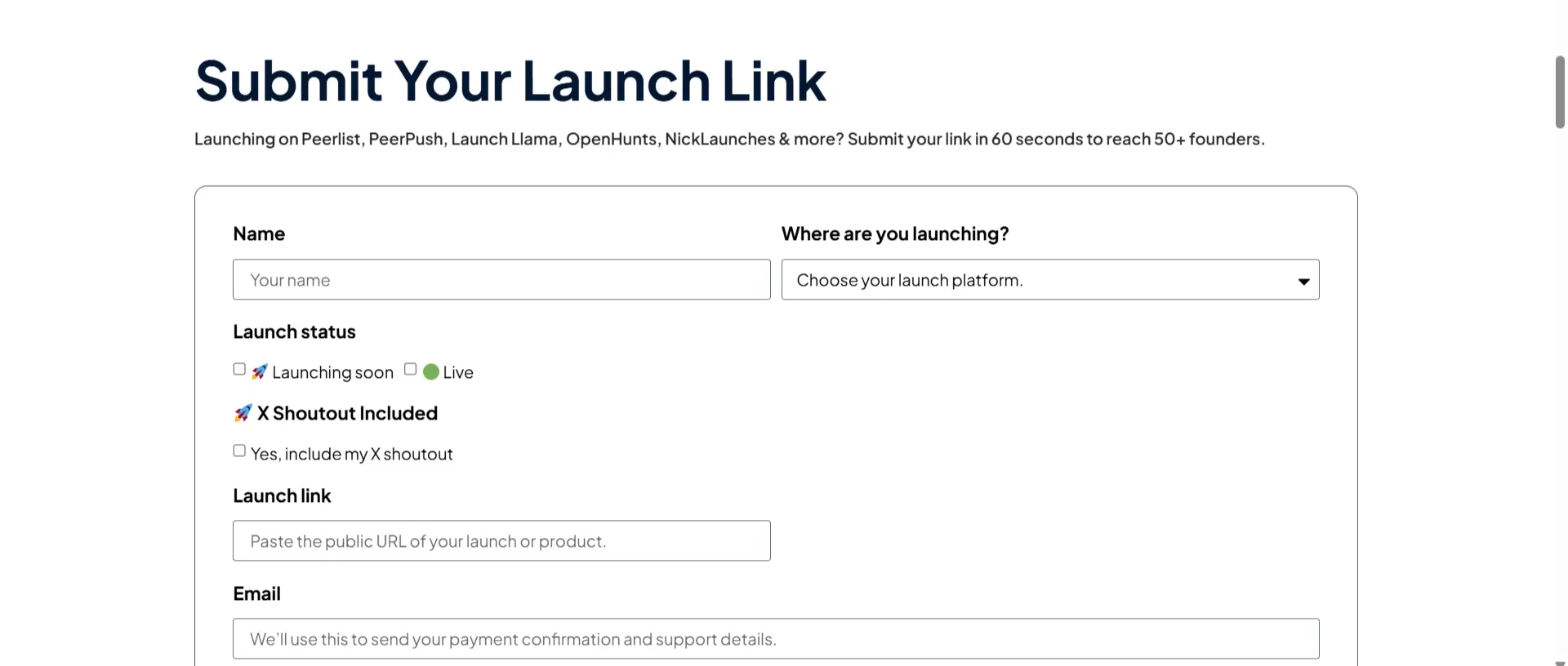
Makerio provides manual, human-powered launch support for founders. For $5, Makerio shares your launch directly with 50+ founders, provides a dedicated X shoutout, and aims to generate genuine feedback and engagement around the launch.
The important distinction is that Makerio is designed to complement your PeerPush launch, not replace it.
You still control the product page.
You still talk to users.
You still answer questions.
You still collect feedback and improve the product.
Makerio simply adds another layer of human distribution so that you’re not relying entirely on your own audience to create the initial push.
Makerio says its support is manually handled rather than automated, and it explicitly supports launches on PeerPush along with other launch platforms.
It can be useful for founders who:
- Have a small audience
- Are launching for the first time
- Want additional founder exposure
- Need more people to discover their product
- Prefer human-powered distribution
- Want support alongside their own launch efforts
No launch service can guarantee users, revenue, or product-market fit. Your results will still depend on the quality of the product, positioning, landing page, and follow-through.
But when you want more people to see the launch while you focus on talking to the people who do show up, an additional distribution channel can make the launch less dependent on your existing audience.
What Should You Expect from a PeerPush Launch?
Honestly, it depends.
Your results will be influenced by:
- Product quality
- Market demand
- Positioning
- Launch-page quality
- Existing audience
- External promotion
- Timing
- Conversion funnel
- Your follow-up
A successful launch does not necessarily mean thousands of clicks.
You might get:
- A handful of new users
- Several useful conversations
- Better product positioning
- Qualified traffic
- Email signups
- New product ideas
- Founder connections
- Your first paying customers
A launch with ten highly relevant users can be more valuable than a launch with ten thousand visitors who never try the product.
The real question is not:
“How many people saw my launch?”
It is:
“What happened after people saw it?”
PeerPush Launch Checklist
Before you publish, check:
- Product ready: Signup works from beginning to end
- Positioning clear: You can explain who it is for and what problem it solves
- Launch page complete: Description, visuals, CTA, and relevant product information are ready
- Visuals ready: Use real screenshots or a short product demo
- CTA tested: Your main action works and is obvious
- Analytics ready: Track traffic, signups, and activation
- Promotion prepared: Social posts, emails, and outreach are ready
- Time available: You can respond to comments after launch
- Feedback process ready: You have somewhere to record what users tell you
- Follow-up planned: Know how you will contact interested users after they try the product
- Next step ready: Have your next product update or distribution action planned
FAQ
What is PeerPush?
PeerPush is a product discovery platform focused on helping people discover products from indie makers, startups, and technology builders. It supports product listings, ratings, comments, updates, and structured product information designed for both people and AI discovery.
Is PeerPush legit?
PeerPush is an active product-discovery platform with published rules, public product listings, and transparent pricing. It also publishes audience figures on its website. Like any launch platform, the value you get will depend on your product, promotion, and conversion funnel.
How do I launch a product on PeerPush?
Create your account, prepare your product information and visuals, review your landing page, choose the appropriate submission option, and publish through PeerPush’s current submission flow. Check the platform’s live requirements before launching.
How do I promote a launch on PeerPush?
Share the launch through relevant channels such as X, LinkedIn, newsletters, communities, founder networks, existing customers, and personal outreach. Give people context instead of repeatedly dropping the same link.
How do I get users from PeerPush?
Optimize the journey from discovery to signup. Make the landing page clear, reduce signup friction, get users to their first useful result quickly, and follow up with early users to understand what they need.
How do I get feedback on PeerPush?
Ask specific questions rather than “What do you think?” Look for repeated patterns in comments, ratings, and conversations. Use that feedback to improve positioning, onboarding, pricing, and product usability.
Is PeerPush good for indie hackers?
PeerPush is specifically designed for indie makers, startups, and tech enthusiasts, making it a relevant discovery channel for solo founders and early-stage products. It works best alongside other channels rather than as the only source of distribution.
Can I launch a SaaS product on PeerPush?
Yes. SaaS products are one of the types of products featured on the platform, alongside AI tools, developer tools, extensions, and other technology products.
Where should I launch my SaaS product?
There is no universal answer. Depending on your product and audience, you might combine PeerPush with Product Hunt, Hacker News, Reddit, Indie Hackers, social platforms, niche directories, and founder communities.
Can Makerio help with a PeerPush launch?
Yes. Makerio offers manual, human-powered launch support for $5, sharing your launch directly with 50+ founders and providing a dedicated X shoutout. PeerPush is one of the launch platforms Makerio currently supports.
Final Thoughts
Launching on PeerPush gives you another opportunity to put your product in front of potential users, builders, and people actively discovering new software.
But publishing the launch is only the beginning.
You still need to explain the product clearly, promote it to the right people, answer questions, collect feedback, follow up with early users, improve onboarding, and keep distributing the product after launch.
That is where most of the real value is created.
For founders who want an extra distribution push, Makerio provides manual, human-powered launch support for $5, putting your product in front of 50+ founders and adding a dedicated X shoutout alongside your own launch efforts. There are no bots or automated launch sharing; the service is designed to add human-powered exposure around the launch you’re already doing.
Ready to launch on PeerPush? Publish your product, start the conversation, learn from the people who show up, and keep building from there. And when you want an extra push, check out Makerio’s launch support.